
How To Ensure Your Best Operations Happen Without You: The Character Architecture Framework
Anyone can behave when life corrals them. Only someone ready for leadership behaves when no one is watching.
Executive Summary
The Core Insight: The difference between a good hotel and a great one isn't written in the SOPs: it's encoded in what happens when the SOPs aren't being checked. Compliance is what people do when they're watched. Character is what they do when they're not. Senior leaders don't build teams that follow rules; they build teams that embody standards.
Why This Matters: As properties scale, leaders scale themselves through systems. But systems without character create theatrical service: perfect when observed, inconsistent when not. The properties that win long-term are those where night audit integrity matches day shift performance, where back-of-house standards mirror front-of-house polish, where the last room cleaned gets the same attention as the first.
What You'll Learn:
The watched/unwatched diagnostic: mapping where your operation performs vs. where it performs only when observed
Why compliance cultures plateau and character cultures compound
The architecture of self-governing teams in hospitality
Practical frameworks for hiring, onboarding, and leading for character
Time Investment: 12-minute read | ROI: A lens to diagnose operational integrity gaps and a blueprint to close them
📸 Chapter Snapshot
What This Insight Covers:
The Compliance Trap: Why rules create robots, not leaders
The Watched/Unwatched Diagnostic: Where is your operation theatrical?
Character Architecture: Building teams that police themselves
The Hiring Lens: Spotting character in interviews
The Leadership Imperative: Modeling the unwatched standard
Part 1: The Compliance Trap—When Good Enough Becomes the Enemy of Great
Walk into most hotels at 3pm during manager rounds, and you'll see perfection. Walk in at 3am when the night audit is alone at the desk, and you'll see the truth.
This gap—the difference between observed performance and unobserved performance—is the single most reliable predictor of long-term guest satisfaction, team turnover, and operational consistency.
The problem isn't that people don't know what to do. The problem is that knowing isn't the same as being.
Compliance asks: "What do I have to do to avoid getting in trouble?"
Character asks: "What's the right thing to do, even if no one will know?"
Hospitality has spent decades building compliance cultures:
Checklists that get ticked without being read
Mystery shopping that creates "show time" behaviour
Corrective action systems that punish deviation but don't inspire excellence
SOPs so detailed they remove judgment, and with it, ownership
The result? Properties where service is a performance, not a practice. Where staff behave impeccably during GM walkthroughs and cut corners the moment leadership leaves the floor.
This is the compliance ceiling: you get rule-following, not standard-setting.
Why Compliance Cultures Plateau
1. They optimise for avoidance, not excellence
When the goal is "don't get caught", the standard becomes "good enough to pass inspection." Staff learn to game the system—looking busy when managers appear, hiding problems rather than solving them, performing service rather than delivering it.
2. They create dependency, not autonomy
Compliance requires external enforcement. Remove the enforcer, and performance degrades. This is why properties with heavy supervision often have terrible off-hours service—the team has learned that standards only matter when someone's checking.
3. They attract rule-followers, not standard-bearers
Compliance cultures select for people who need to be told what to do. Over time, your best people—the ones who take initiative, who care about outcomes, who lead from the middle—leave. They're replaced by those who stay in lane, wait for instructions, and never challenge mediocrity.
The hospitality industry's dirty secret: Most properties are running compliance systems and wondering why they can't achieve excellence.
Part 2: The Watched/Unwatched Diagnostic—Mapping Your Operation's Integrity Gaps
Here's the framework that changes everything. Map your operation across two dimensions:
Dimension 1: Visibility (How often is this activity observed by leadership?)
High visibility: Front desk during peak check-in, restaurant service during dinner rush, housekeeping during manager rounds
Low visibility: Night audit, early morning breakfast prep, housekeeping after 2pm, engineering repairs, back-dock receiving
Dimension 2: Performance (How consistently does this activity meet your stated standard?)
High performance: Consistently excellent
Variable performance: Good when watched, inconsistent when not
Low performance: Rarely meets standard
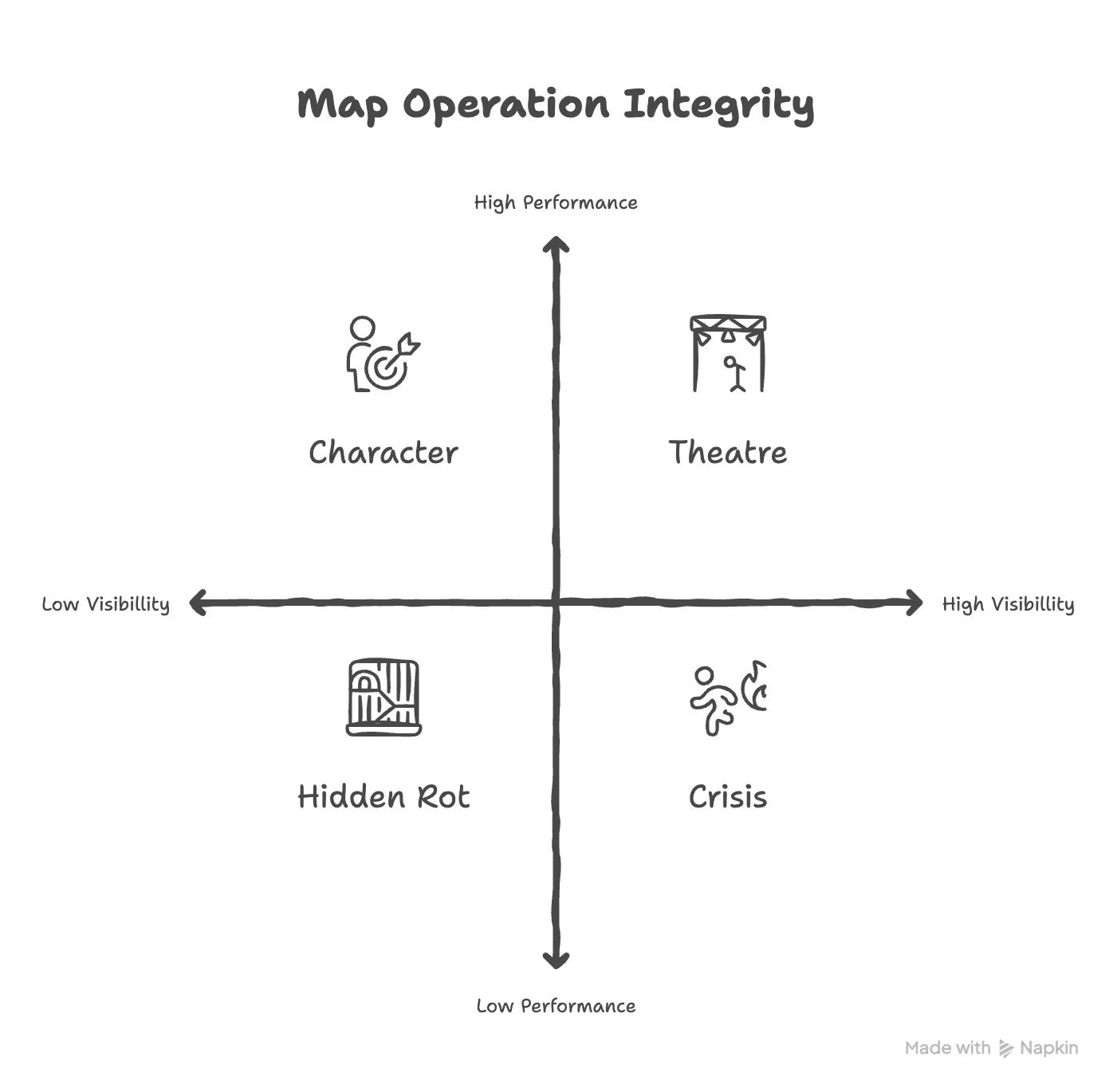
The Four Quadrants
Quadrant 1: High Visibility + High Performance = Theatre
This is your "show time" operation. Guest-facing, leadership-observed, consistently excellent. Front desk during manager rounds. Restaurant service when the GM is in the room. Pre-opening deep cleans.
The trap: Mistaking theatre for culture. If performance is high because visibility is high, you haven't built excellence—you've built performance anxiety.
Diagnostic question: What happens to this area's performance when leadership isn't present?
Quadrant 2: Low Visibility + High Performance = Character
This is where culture lives. Night audit integrity. Housekeeping quality on the 23rd room when no one's checking. Kitchen prep standards at 6am when the chef isn't in yet. Engineering follow-through on maintenance tickets.
When performance stays high even when no one's watching, you've built character into the operation. This is the gold standard.
Diagnostic question: How many of your operations live here? If the answer is "not many," you have a character problem, not a training problem.
Quadrant 3: High Visibility + Low Performance = Crisis
When even your showcase operations are failing, you have fundamental execution problems. This is typically a leadership failure—either the standard isn't clear, the team isn't capable, or both.
Fix this first. You can't build character until basic competence exists.
Quadrant 4: Low Visibility + Low Performance = The Hidden Rot
This is where your brand is dying in the dark. Back-of-house cleanliness. Maintenance response times. Staff area conditions. Inventory management. Vendor relationships.
Low visibility means low priority. Low performance means guest experience is eroding in ways you don't see until it's too late—until a Google review mentions the mouldy bathroom grout, the broken minibar, the surly night staff.
The brutal truth: Most properties have 60-70% of their operation in Quadrant 4. They just don't know it yet.
Running the Diagnostic
Step 1: List every operational touchpoint (30-50 activities across departments)
Step 2: Rate visibility (How often does senior leadership directly observe this?)
Daily = High
Weekly = Medium
Monthly or less = Low
Step 3: Rate performance (How consistent is execution against your standard?)
Use anonymous staff surveys, guest feedback, and your own unannounced spot-checks
Be honest. If you're not sure, assume it's worse than you think.
Step 4: Plot the map
Now you can see your operation's integrity landscape. Where does character live? Where is performance theatrical? Where is the hidden rot?
The goal: Move everything to Quadrant 2. High performance, regardless of visibility. That's a character-driven operation.
Part 3: Character Architecture—Building Teams That Police Themselves
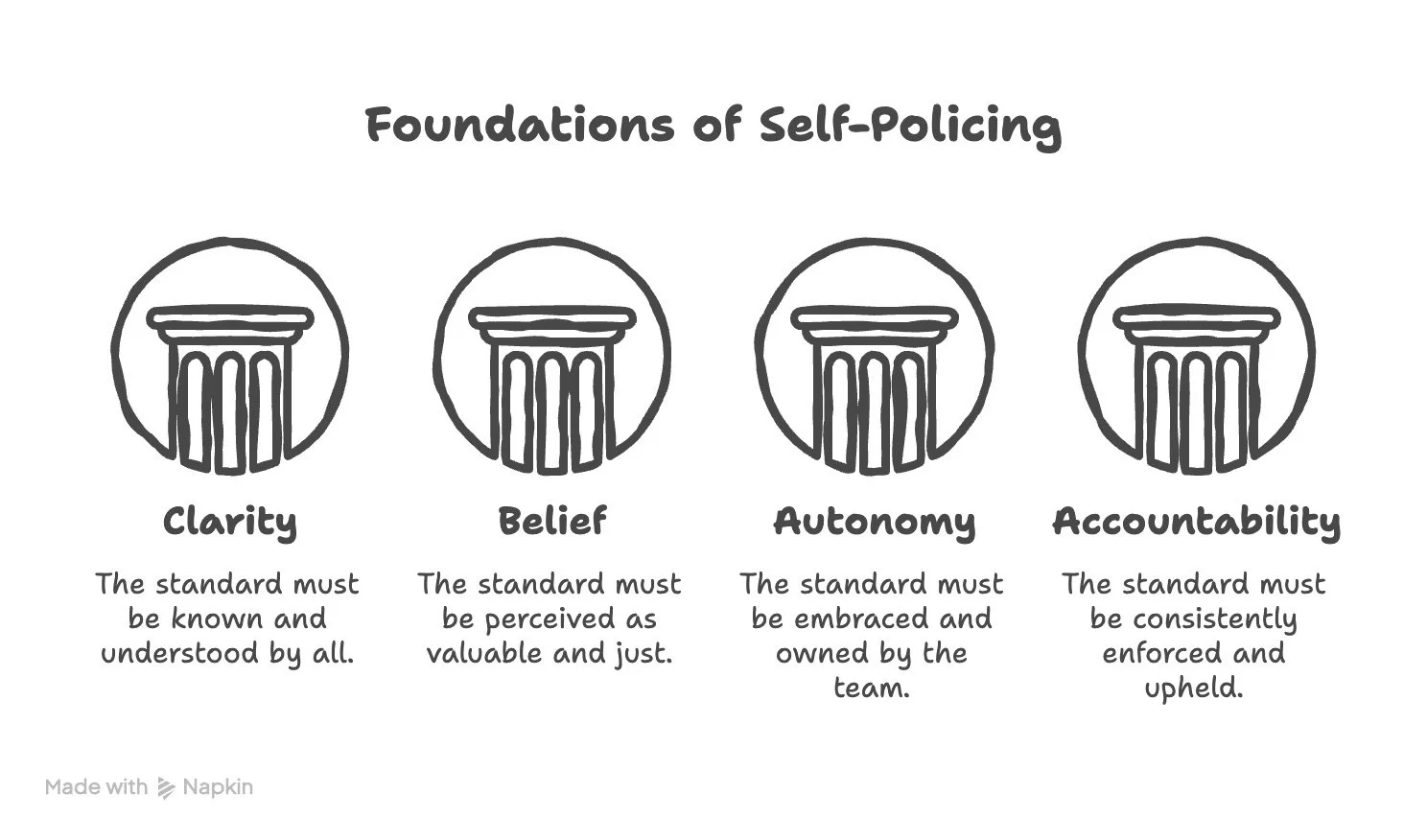
You can't supervise your way to excellence. If character is "what you do when no one's watching," then the only sustainable path to operational excellence is building teams where people govern themselves.
This requires four architectural pillars:
Pillar 1: Clarity (The Standard Must Be Known)
Character can't exist without clarity. If people don't know what "right" looks like, they'll default to whatever's easiest.
The test: Can any team member, in any department, at any level, articulate your property's service standard in their own words?
Not the mission statement. Not the brand promise. The actual behavioural standard.
What does a perfect room handover look like?
What's the response time for a guest request?
How do we handle a complaint?
What's the standard for staff area cleanliness?
If the answer is "check the SOP," you've failed. SOPs are references, not culture. Culture is what people carry in their heads and hearts.
Action: Reduce your service standard to 5-7 non-negotiable behaviours. Make them memorable. Repeat them until every team member can recite them.
Pillar 2: Belief (The Standard Must Be Worthy)
People don't uphold standards they don't believe in. If your standard is arbitrary, punitive, or disconnected from guest value, compliance will require enforcement.
The test: Do your people believe the standard matters?
This is where most properties fail. They mandate behaviours without explaining why. "Greet every guest within 10 seconds"—why? "Deep clean the minibar daily"—why?
Without the "why," standards feel like bureaucracy. With the "why," they feel like craftsmanship.
Action: For every standard, teach the guest impact. "We greet within 10 seconds because arriving at a hotel is disorienting—our acknowledgment says 'you're safe, we see you, we're ready to help.' That feeling is the foundation of their entire stay."
Pillar 3: Autonomy (The Standard Must Be Owned)
Compliance is imposed. Character is chosen.
If people feel controlled, they'll perform when watched and relax when not. If they feel ownership, they'll self-correct because they care, not because you do.
The test: Do your people have the authority to uphold the standard without asking permission?
Can a housekeeper re-clean a room if it doesn't meet their standard, even if it delays their shift end? Can a front desk agent comp an amenity to fix a guest issue without calling a manager? Can a line cook refuse to send a dish that isn't perfect?
If the answer is no, you've built a compliance system. People will wait for permission, defer to authority, and never take ownership.
Action: Define the boundaries of autonomy clearly, then trust people to operate within them. Celebrate when they use judgment, even if the outcome isn't perfect.
Pillar 4: Accountability (The Standard Must Be Real)
Character without accountability is just good intentions. If people can ignore the standard without consequence, it's not a standard—it's a suggestion.
But here's the nuance: accountability in character-driven cultures isn't punitive. It's social.
The test: Do your people hold each other accountable, or do they wait for management to enforce?
In compliance cultures, accountability is vertical (manager to staff). In character cultures, it's horizontal (peer to peer).
When a team member sees a colleague cutting corners and says, "That's not how we do things here," you've built character. When they stay silent and wait for a manager to notice, you've built compliance.
Action: Create peer accountability rituals. Daily huddles where teams review yesterday's performance. Shift handovers where quality is verified before the next team takes over. Public recognition of those who uphold standards, especially when it's hard.
The architecture works when all four pillars exist. Remove one, and character collapses back into compliance.
Part 4: The Hiring Lens—Spotting Character Before They're on Your Payroll
You can train skill. You can't train character.
This is the most important hiring principle in hospitality, and the most ignored. Properties spend hours testing technical competence (Can you fold a napkin? Do you know PMS software?) and minutes assessing character (Will you care when I'm not looking?).
The result: teams full of competent people who don't give a damn.
The Character Interview Framework
Forget the standard questions ("What's your greatest weakness?" "Where do you see yourself in five years?"). They reveal nothing.
Instead, use behavioural prompts that expose character:
Question 1: "Tell me about a time you did the right thing even though no one would have known if you didn't."
What you're listening for: Do they have an example? Is it specific? Do they articulate why they did it, not just what they did?
People with character have stories. People without character stumble.
Question 2: "Describe a situation where you saw a colleague cutting corners. What did you do?"
What you're listening for: Did they act, or did they stay silent? Did they defer to authority, or did they engage directly?
Character shows up in how people handle peer accountability.
Question 3: "You're closing the restaurant. It's been a long shift. You notice a table setting isn't quite right—minor, but not perfect. No one else will see it before tomorrow's opening team arrives. What do you do?"
What you're listening for: Do they fix it, or do they rationalise leaving it?
The answer tells you everything. Character-driven people fix it because that's who they are. Compliance-driven people leave it because no one's checking.
Question 4: "What's a standard you hold yourself to that goes beyond what your last employer required?"
What you're listening for: Do they have one? Is it genuine, or does it sound performative?
People with character set their own bar. People in compliance cultures wait to be told where the bar is.
The Reference Check That Matters
When you call references, ignore the standard script. Ask one question:
"If you were launching a new property and could only bring five people, would this person be one of them?"
Then listen to the pause. If they hesitate, you have your answer.
Character is rare. People who have it are unforgettable. References for character-driven employees sound different—more emphatic, more specific, more emotional.
Hire for character. Train for skill. Win for decades.
Part 5: The Leadership Imperative—You Are the Standard When No One's Watching
Here's the hardest truth in this insight:
Your team's character ceiling is your character ceiling.
If you cut corners when no one's looking, they will too. If you rationalise exceptions for yourself, they'll rationalise exceptions for themselves. If you treat back-of-house differently from front-of-house, they'll internalise that hierarchy.
Character-driven cultures don't happen by accident. They're built by leaders who are the standard, not just those who enforce it.
The Private Leadership Test
What do you do when no one's watching?
Do you walk past a piece of rubbish in the corridor, or pick it up?
Do you acknowledge the stewarding team as intentionally as you greet the front desk?
When you're exhausted and a small operational issue arises, do you fix it or defer it?
Do you hold yourself to the same punctuality standard you expect from your team?
Your team is watching. Not when you think they are—always.
The night supervisor sees whether you're still on property at 9pm or gone by 6pm. The housekeeping team notices whether your office is organised or chaotic. The kitchen staff watches how you treat vendors, how you handle stress, whether you say thank you.
Character is caught, not taught.
You can mandate behaviours, but you can't mandate beliefs. The only way to build a character-driven culture is to be a character-driven leader—consistently, privately, when it would be easier not to.
The Unwatched Leadership Standard
Commit to this: For the next 30 days, act as if every decision you make in private will be made public.
Every email you send
Every conversation you have
Every standard you uphold or ignore
Every moment of integrity or compromise
How does your leadership change?
That gap—between how you lead when watched and how you lead when not—is the integrity gap your team is modelling.
Close it, and you give them permission to close theirs.
10X Box: The Question That Changes Everything
If your entire operation performed at the level it does when no one's watching, would you still be in business?
If the answer is no, you don't have an operations problem. You have a character problem.
And character problems don't get solved with more checklists, more supervision, or more corrective action plans.
They get solved by building teams who care—not because they're watched, but because of who they are.
That's the game. That's leadership.
Final Thought: The Long Game
Compliance is fast. Character is slow.
You can mandate a behaviour today and see it performed tomorrow. But you can't mandate belief. You can't mandate ownership. You can't mandate the choice to do the right thing when no one's looking.
Character takes time. It requires patience, consistency, and a willingness to lead differently than the industry norm.
But here's what you get:
Operations that don't degrade when you're not present
Teams that take pride in their work, not just their paycheque
Guest experiences that are consistent, not theatrical
A culture that attracts and retains the best people in the industry
A property that doesn't just perform—it endures
Anyone can behave when life corrals them.
Only someone ready for leadership behaves when no one is watching.
Build that. Build teams full of those people. Build a culture where character is the expectation, not the exception.
That's how you win the long game.
Key Takeaways
Compliance gets you rule-following; character gets you excellence. The gap between observed and unobserved performance is your culture's true measure.
Use the Watched/Unwatched Diagnostic to map where your operation is theatrical (high visibility, high performance) vs. where character lives (low visibility, high performance).
Character architecture requires four pillars: Clarity (the standard is known), Belief (the standard is worthy), Autonomy (the standard is owned), Accountability (the standard is real).
Hire for character, train for skill. Use behavioural interview questions that expose how candidates behave when no one's checking.
Your team's character ceiling is your character ceiling. Model the unwatched standard—act as if every private decision will be made public.
The goal: Move 80% of operations to Quadrant 2 (high performance, regardless of visibility). That's a self-governing, character-driven operation.
Character is slow, but it compounds. Compliance cultures plateau. Character cultures build momentum and attract the industry's best people.
This insight is for the leader who's tired of theatrical service and ready to build something real: a culture where excellence isn't performed, it's practiced. Where people don't behave because they're watched, but because of who they are.
Ready to build self-governing teams at your property?
I’ve helped hotel owners, CEOs, COOs, and GMs implement the Character Architecture Framework across operations: from hiring for character to building peer accountability systems that stick.
If you want a tailored implementation plan for your property, let’s talk
Prabhjot Bedi | +91 9872000604 | p.bedi@eclathospitality.com